Is the Design Process Dead? Was it Ever Alive?

If you’re a designer, you may have read Jenny Wen’s post on the death of the design process, or watched some videos about it. It’s provocative, perhaps blasphemous to some, bt it’s certainly started a conversation. When I read it, I could help but consider if we, as a practical matter, ever really followed the Design Process at all? I’m sure there are some designers start each project by setting up their planning boards and beginning their persona analysis, but if we’re being honest, most of us start by reading up on the requirements, take a quick look at who’s using it and what task they’re to accomplish in the app, and then we start sketching. Unless you’re new to a team, don’t have prior knowledge about the users, or their goals, most designers jump right in with a little flow mapping, or a quick set of sketches to visualize the idea.
What is meant by following a process?
To review: Our old friend, the double diamond
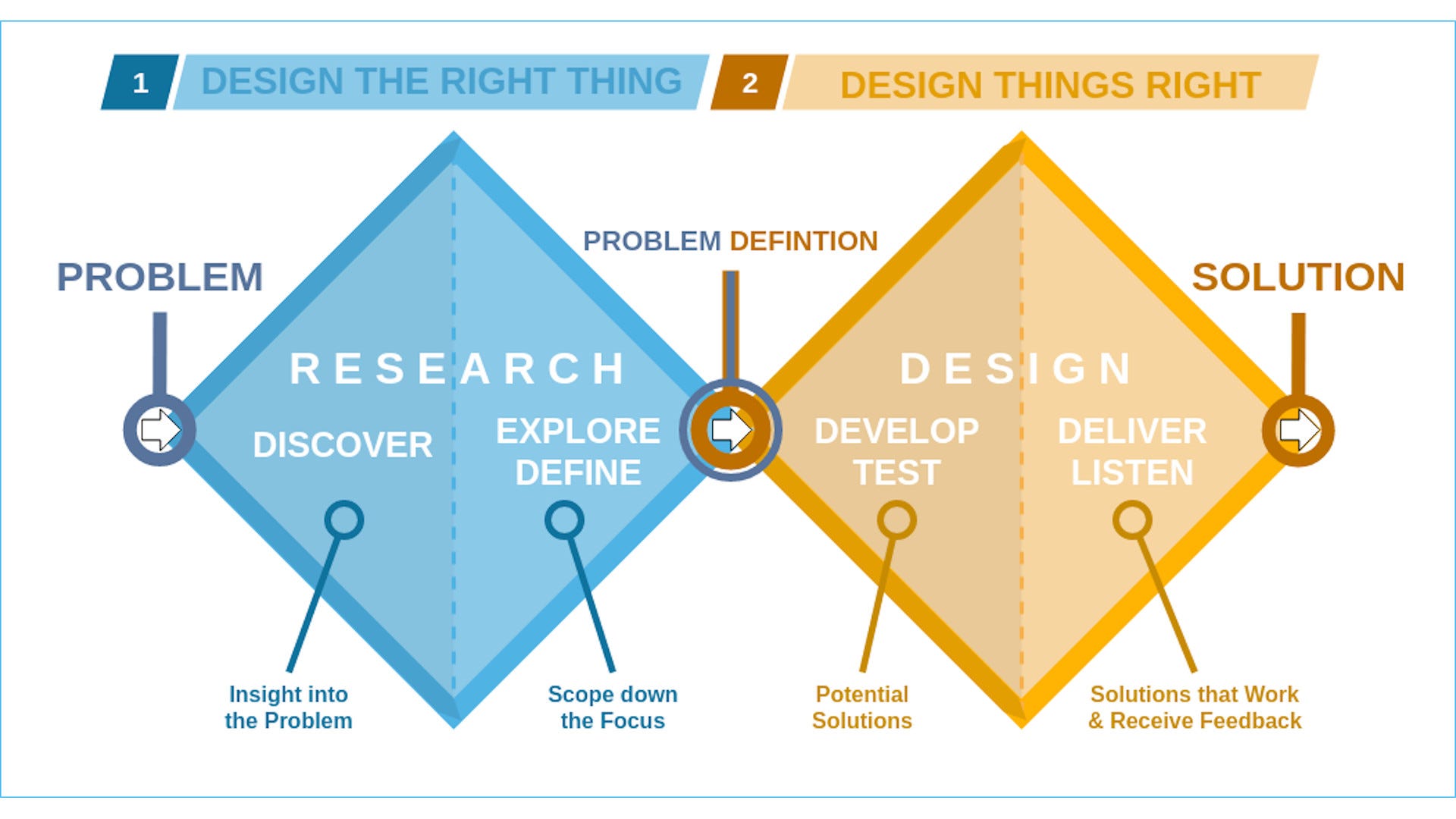
To say that a designer, or a team, is following the Design Process, specifically the one laid out by the British Design Council in 2005, feels a bit like saying that our development teams follow a strict agile process. Everyone nods and the corner of your mouth tilts up because you know what they mean. What’s being said is that we do some tasks that are inspired by the manifesto, but you may have to squint to really see it. This is normal and I would argue, necessary to getting work done in a timely manner. These are principles and high-level concepts that are meant to inform your work. These methodologies are never meant to be followed to the letter, without question, each time we perform a design action. They are meant to lay out a set of concepts and artifacts that lead to a good design. Know the process, then decide which steps to take in order to inform your current assignment.
So when would you follow this process to the letter? If I were starting out as a founding member of a team tasked with building a brand new app, I would likely “walk the diamonds” pretty closely. How else would you nail down what to build, the personas you wish to target, what their goals are for this app, etc.? However, a few years into working on that app and I would likely have most of the knowledge the process fleshes out and could confidently jump to iterating on the pixels, not so much working to discover the “why” of it.
All of these thoughts, articles and podcasts around what the future of design work seem to be coalescing around three arguments. First, that the cost of production (coding) is dropping to near zero (debatable, but let’s go with it for a moment) and for some, that means that designers should start their work with AI coding agents and iterate from there. Second, if it’s true that production costs are moving to zero, the only thing that will distinguish good products from bad is design. Finally, design isn’t really about prototyping and sketching at all, it’s about the intangibles of developing taste and craft. Let’s dissect these arguments.
Starting your work with agents
Should we jump into agentic coding to begin working toward a viable product, rather than a discovery and prototyping motion? For agentic design, the idea is to build out a markdown file describing what you’re looking to create, likely with some rules and boundaries around design specifications and systems. Basically, creating a kind of PRD for the agent to use while it thinks about what you’re trying to build. This works great when you have all the outcomes and specs in place, which will require you to do some discovery and research, or to put it another way, the first diamond.
As the designer, or perhaps with the team, you’ll then iterate on the output of the agent, working to refine based on feedback, or design principles, adding more to the markdown file as needed, prompting along until you get something you’re happy with. To put that another way, working the second diamond. So basically,this argument comes down to the tool you use to do the work, not the process by which you design a good product. The savings here is that there’s no handoff to an engineering team at the end. The end of design is the coded product. That’s useful, for sure, but you didn’t really kill the design process.
Design as the differentiator
If “anyone” can vibecode their way to any product, then the only way to win in the market is to have a well designed offering. I feel like this is the logical conclusion when people rediscover that good design is a key component to winning and keeping business. AI can certainly make “good enough” products. A mediocre, but acceptable app that does what you need, in a way that’s functionally proficient, if not a joy to use, but can get the job done.
So with that same lens, a proficient designer, using these same tools, should be able to guide the AI in such a way that creates a design-first vision of the same type of product. If done well, this will net you a product that people enjoy using, and still gets the core job done. As we go forward in this new way of building products, it will become more critical to find and leverage this type of design-first mentality. When production cost is equal, then the best design wins.
What is the role of design in this new idiom?
In this new world, if it goes the way the pundits are saying, design becomes the existential path for product building, so it’s a good time to talk about the intangibles that surround it. Why is one design better than another? What quantifies good design? I suppose also, can we teach AI these principles? Leaving the last question to later, good design consists of two elements. The first is often referred to as having good taste. This is the ability to distill ideas into elements of desire and joy. I recently read an excellent breakdown of “taste” by Joshua Leigh, titled “Taste is not a feature”. He defines taste as the following:
Taste is not a fixed trait or an innate gift. It is an accumulated capacity for contextual judgement, shaped by what you’ve been exposed to, what you’ve chosen to pay attention to, and how honestly you’ve reckoned with the distance between what you thought was good and what turned out to be.
Non-designers hate this kind of thing. It can’t be coded, or a rule created to capture it. It is the essence of how humans experience and judge elements they come into contact with in life. It’s not a binary good or bad, it’s subjective, yet nearly all humans know when they see something that has been created with great taste. Something that is often referred to as “timeless”. Some design ideas come and go, some have staying power. These are all elements of taste. Some basic elements of taste can be taught. For example, you can teach someone color theory, or how to evaluate elements that make up good design decisions from the past. This is how you can begin to develop good taste, but applying it forward to something new is the trick. It takes years to develop an understanding of good taste and apply it in a pragmatic way. Most non-designers don’t bother. They know it when they see it. Designers can create it.
The second element of design is craft. Craft is the process for getting to good design. Craft is how a designer goes about creating, implementing and iterating on a design. Methodologies like the Design Process mentioned above can help with this, but that’s not craft. Craft is the beautifully individualized journey that each designer takes in creation. Craft is the deployment of skills, tools and that elusive idea of taste against a particular idea or goal in order to achieve something both useful and enjoyable. Like taste, you can teach some of the elements of craft. I can train you to use Figma, but making something beautiful with it is an individual path.
It’s said that great design is invisible, but bad design is obvious. I often run into folks at work who, when putting something together for a deadline, ignore these elements in favor of “getting to market”. Equally often, these are the very same people who can complain, ad nauseam, about bad design in other products. When you give these folks an AI agent, they get really excited. AI is great at looking backwards. It can produce the good synthesized version of all the things you have seen before, or are currently in fashion, but it can’t create something new. It can’t build something timeless. Great design often comes when breaking with established rules and trying something different. AI is not built for capturing intangibles or breaking with tradition. My bet is that agentic design will be a race to the mediocre. Just good enough to release, but usually utterly forgettable and endlessly poachable by others. Great design, regardless of process, will always be desired over masses of functionality. The companies who recognize this now will be able to build moats around their offerings based in large part on the design of their products, not the features list.
Long live the design process.